Episode Transcript
[00:00:00] Sarah: Foreign.
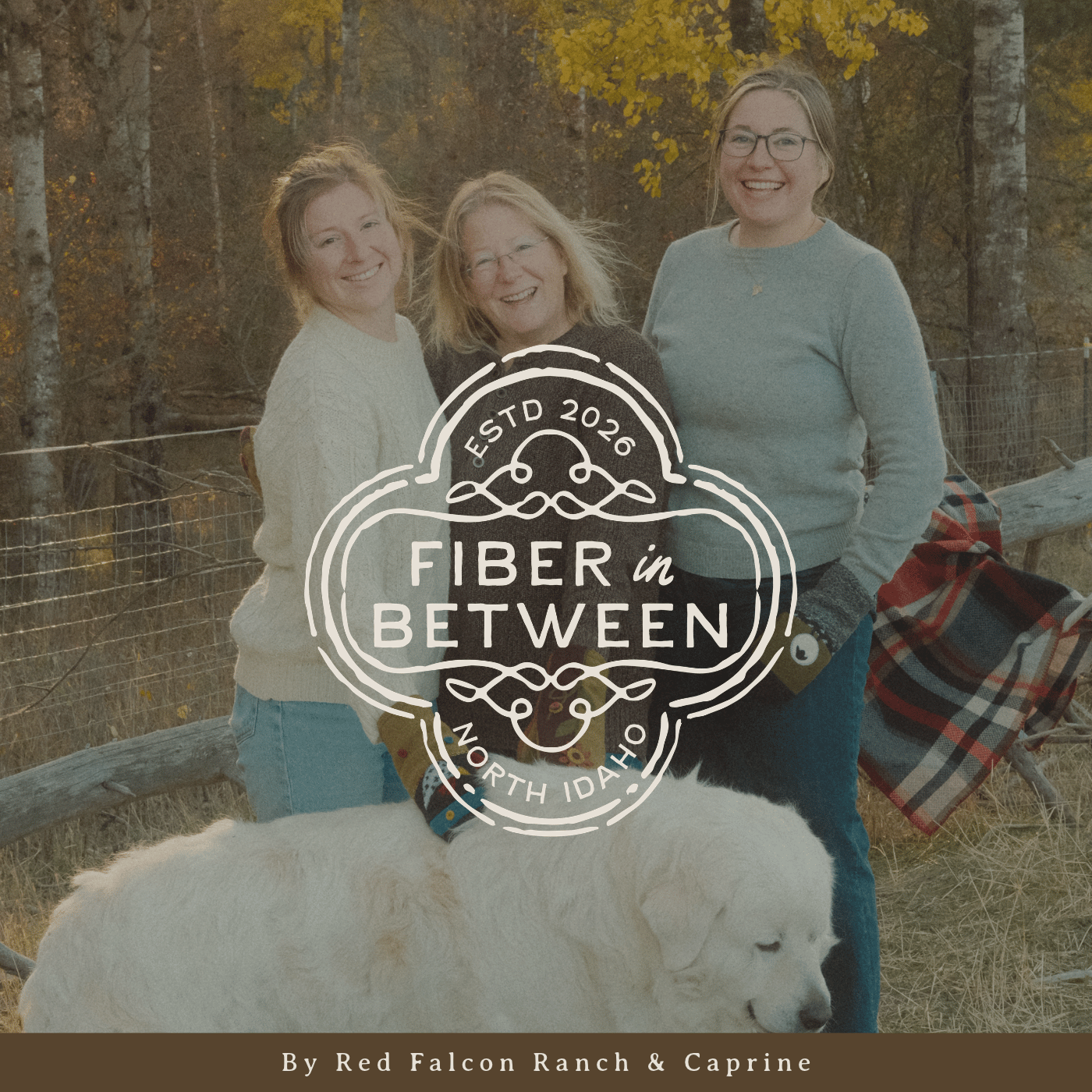
Hello, and welcome to Fiber In Between. This is our very first podcast episode, and we're so excited you're here. I'm Sarah, and this podcast has been my dream since April 2021 to just dive deeper into what we're doing on the ranch and Caprine and literally everything in between.
So if you're someone who's been following along at Red Falcon Ranch and want to hear us dive deeper, than, this is quite literally for you.
[00:00:30] Rachel: Yep.
So that is your host, Sarah.
You want to introduce yourself a bit more? No, that's fine, Sarah. Keep it going. It's fine.
[00:00:40] Angela: First podcast. This
[00:00:41] Sarah: is our first podcast
[00:00:42] Angela: podcast, and this is in real life. Okay.
[00:00:45] Sarah: So here on the ranch, there's basically three prongs. There's three of us gals, Mom Rachel and myself. Rachel runs Red Falcon Ranch, mom runs Caprine, and I run Fiber in Between, which
[00:00:57] Rachel: has been Sarah's passion project for many years. This has been a long time coming, a long time in the making.
Right now, we are down in the dip. So for those of you that follow us on Red Falcon Ranch, you know exactly where the dip is.
So this is often where the predators come in and you hear the guard dogs barking at night. We actually have Sven to my left sleeping soundly, and mom is currently cuddling Olaf the Does. So our herd of goats are totally surrounding us right now. All the leaves are golden, and it's actually nice and quiet right now, which is good. We don't. There's no wind. So this is the perfect time to do the podcast for our first episode. So bear with us as we try to corral all our thoughts into one topic, which will simply be introduction. So. So I am Rachel. I am the face you see for Red Falcon Ranch. So that is what I run and run all the social media and most of the stuff that has to do with Red Falcon Ranch, such as all the shearing, all the hoof trimming, health maintenance for all the goats, all that, et cetera. And I will now let Sarah reintroduce herself, since this is her baby. Thank
[00:02:13] Sarah: you. So, yes, as you probably know, I'm Sarah, so I do a lot of the things behind the scenes here on the ranch. I'm sending out the newsletters, I design the website. I do all like the visuals you see kind of thing behind the scenes that just get sent out. I do most of our photography and all that kind of stuff. I'm also one of our chief goat catchers, so whenever we need to catch one, I'm out doing that out Doing chores every morning too. We all work together and then.
Oh, Rachel, you're doing great.
[00:02:46] Rachel: I'm filming Sarah right now so we can do a vlog.
[00:02:48] Sarah: So when we do an Instagram live, it's like, no stakes. But for some reason, filming this podcast seems very high stakes to me right now. But yeah, so I'm usually not the voice of everything, and I am now, so I'm just getting used to that there. So I'll let mom introduce herself.
[00:03:03] Angela: My name is Angela and you do not see much of me behind the scenes or in front of the camera. I'm like the silent, quiet person in the background. Usually I'll be out in my garden if you can't find me.
Long, long time ago, before there were computers, I actually went to university and have a degree in business management, marketing, production, supply chains.
So I took all of that that I've learned over the years through my academic work and just hands on with these goats that we raise.
And I created Caprine and that's my baby. So I manage our supply chains for the socks and the throws. I coordinate with our different supply chain partners and those that do our knitting and our weaving.
And once it all gets here, then Sarah jumps in and she does a fabulous job sharing it all with you through her beautiful photography.
If you hear noises in the background, which I hope you can hear, we have our guard dogs right here with us and the goats are around us. So if you hear noises, that's them. So I hope you get to enjoy that along with us.
Like I said, I'm the mom and I work with my two daughters, which is an absolute blessing since we are family and not just employees. We can have deep discussions on lots of things and deep disagreements. And it's been quite an interesting and fun ride with these two and I'm extremely proud of them. So with that, we can jump into the agenda for the day.
[00:04:49] Rachel: Yeah, so I did create somewhat of a rough outline because we do tend to go down rabbit trails. So since mom kind of brought up her. Her education, I might as well. I
[00:04:59] Sarah: was going to say, what's our credentials here?
[00:05:02] Rachel: So just for a bit of context, I am 27, I'll be turning 28 in December.
And I was. I went to public school until I was in third grade. And not to toot my own horn, but I was in all the advanced groups and stuff. And it was honestly just holding me back because there was so much education happening at home, like whenever the vets would come out or just going on field trips and Whatnot. So I made the decision to be homeschooled.
And that was a really, really great decision for me personally, because honestly, the ranch is an education in itself. And so I have been able to learn and experience more than the average person in that respect.
But I do have a formal education as well. So I did go to the University of Idaho.
I did the Semester in the Wild program there, where I spent three months in the middle of the Frank Church wilderness of no return, where they flew in professors and whatnot. And honestly, those were the best three months of my life.
And I have done three study abroad, so I do include the Semester in the Wild as a study abroad because I didn't see cars or anything for three months. I was literally in a completely separate part of the world, if you will, with 12 other people living out of a canvas tent, taking outdoor showers, we only had an ouse, etc, all the way into the middle of November, so it got kind of cold. But then I did a study abroad in France as well and a study abroad in England with my sister Sarah. I have a bachelor's degree in wildlife resources with a double minor in French and rangeland management ecology. So some of my education is pretty relevant to the life here, which is good. So. So that is my formal education.
And I paid through school via wildland firefighting. So I have done four summers of wildland firefighting. I did that here up where we live, which is really cool. So I've been able to explore all three different mountain ranges that surround our place, which was absolutely amazing. Tons of character development there.
But about halfway through school, mom was diagnosed with wild breast cancer.
So for one whole spring semester, I spent, well, half of one spring semester, from January to March, I spent it at home. I talked with my professors and asked if that was okay, if they could make accommodations for me. Because mom was literally going through the depths of hell with breast cancer and with the ranch and everything, and dad having his own job, it was nigh on impossible to do it all. So I then stayed home, took care of everything while also doing school.
And I did get inducted into two prestigious honor societies, even amidst all that, and always got A's in all my classes, so I'm not just a pretty face.
And then let's see what else happened. Well, in addition to that, that is why I'm still here. So, I mean, I have a degree.
I could go and pursue any career I want. But I came back home to help mom re establish the ranch. And I'm still here because I took over Doing social media a couple years ago and to see where it is now is absolutely insane.
So we are really building a legacy here and I'm very excited to see how it will continue to grow.
[00:08:31] Sarah: Yeah, super cool. Rachel's the whole enchilada.
So a little about me,
[00:08:36] Rachel: whatever that means.
[00:08:38] Sarah: I started homeschooling about the same time Rachel did as well. I went through first grade, had an absolute blast. And then I was homeschooled, which was also a blast. Got to have a lot of fun. When it would be kidding season, I'd be up in the loft in the straw bales doing whatever homework I had to do and then peeking out the pinholes in the metal siding to see if anyone was going into labor. And I always enjoyed doing that and cuddling all the babies. So that was really cool. Definitely a different style of upbringing, one of which I'm quite thankful for. And then I also went to the University of Idaho. I started, gosh, like a year and a half after Rachel, fall 2019. So right before COVID I had one regular semester that was the same semester Rachel was in the wild. So it was just me.
And then it was great. I had a knitting group of friends, we'd go to the cafe and knit, had an awesome time. And then Covid hit, totally changed everything.
And at that same time, I had my own yarn store called pine Rose and Company online. And I started that when I was 17 or 18 years old. And that's how I paid my way through school, was by selling yarn, which was really fun. And I was able to really grow that during COVID because everyone was at home and wanted to do handcrafts. And knitting really boomed during that time.
So that was really cool. When I wasn't doing school, I was dyeing yarn or taking care of the goats. And then when we did the study abroad in England together, that was a super cool time. And I learned that was my first international trip. And I was like, this is amazing. I want to do this forever. I love it. So the following summer I did a study abroad in Italy and I took a street photography course. And that really opened up my world too. So I learned a lot about photography in a condensed six week class and had a ton of fun. So I love taking my camera out and getting pictures of everything just in the moment. I'm not a huge fan of staged things and I also take a lot of the videos that are shared on Red Falcon Ranch. So I always have my phone out taking videos of anything that's happening. It's Kind of like second nature now so that we can share our world with you.
So that's kind of a bit about us. So I ran a yarn shop for like seven years, which I don't really talk about anymore because I closed it in 2024 to focus on Caprine and the ranch because I was getting stretched too thin. However, even though we have more going on than ever, I have such a call to get back into that yarn and fiber world. I mean, we live and breathe mohair every single day. But I loved the crafty side of it and I want to get back into that. And I know a lot of the people that follow the ranch want to see more yarn and stuff. So that's one of my goals with fiber in between is to get back to that yarn and hopefully someday even have an in store shop like downtown. I think that would be so much fun and hold classes and all manner of things.
[00:11:29] Rachel: Sarah has always had a business entrepreneurial mind. So like growing up she had this little pop up tent and she'd buy a bunch of candy and she called it the Lavender Inn. I was her best customer.
Really good deals on candy bars.
So I mean, and then all throughout she had then this polymer clay thing going and then. So she's always been
[00:11:55] Sarah: fresh squeezed. Lemonade pans.
[00:11:56] Rachel: Yeah. Farmer's
[00:11:57] Sarah: market and
[00:11:58] Rachel: like
[00:11:59] Sarah: local fairs,
[00:12:00] Rachel: you name it.
[00:12:02] Angela: You
[00:12:02] Sarah: know what's interesting? Hearing that because I was obsessed with candy when we were younger. So to get more candy I need to sell the candy, make money so I can buy more candy. Likewise, I did the yarn shop because I loved yarn. How can I have more yarn in my life by having a yarn store? That's kind of funny.
[00:12:19] Rachel: Yeah. So very interesting there how we've been able to continue with our interests and talents and now apply them back to the ranch essentially.
[00:12:30] Sarah: I didn't even say what I went to university for.
[00:12:32] Rachel: Well, I think they can probably guess
[00:12:35] Sarah: if you can guess. I did small business and entrepreneurship. That's what my bachelor's is in. Very relevant. I would say I learned more doing my own business and just real world experience and the people I met versus what I learned in the classroom. But
[00:12:50] Rachel: Red Falcon Ranch has really been.
[00:12:52] Angela: You graduated with honors.
[00:12:53] Sarah: Yeah, I graduated with honors too. But I mean, I think that was a very interesting time through Covid and everything. I learned a lot,
[00:13:01] Rachel: but it was interesting. It's interesting with Red Falcon Ranch now because you and mom have really transformed a lot with Caprine from where it was originally,
[00:13:12] Sarah: through
[00:13:12] Rachel: all the different stages to where it's at now with it actually being Red Falcon Ranch again
[00:13:17] Sarah: for sure.
[00:13:18] Rachel: Because if Sarah. Because Sarah was actually handicapped and limited by what she was taught in
[00:13:25] Sarah: business school. I don't want to bash university or anything.
I do think people should, you know, get out of their small towns and experience different things.
What I did with my business when I didn't know anything is when it really thrived. But when I would apply the old school principles of business to it instead of allowing my creativity to inspire it, it very much limited it. And so I'm. I'm a play by the rules type of person. So I was like, this is what I learned. This is what we're going to do when that. That did handicap us.
But we've learned and grown so much with Caprine. I mean, just last month we switched it from Caprine to Red Falcon Ranch. Caprine's nested under it.
What's that, Mom?
[00:14:07] Angela: So Caprine has gone through multiple generations, I guess you could say we started out thinking what we thought Caprine should be and who our target market should be and how the product would look and be packaged and discovered that was not necessarily resonating with the people just to put
[00:14:29] Rachel: a plug in here. Sarah and mom are both perfectionists and are extremely good at what they do. And that has actually been the biggest handicap for them because mom has made the packaging look like it's right out of like darn tough or smart wool. I mean, we did the sandpoint art fair. Mom and Sarah had matching T shirts. They had the packaging just on par. And you know what people did? They walked straight on by because it's looked like. It looked like they were.
[00:15:00] Angela: Looked like we were an outlet for
[00:15:01] Rachel: some hours.
And when people came in and we're like. We told them we're. It's just us and we live just north of Bonners. They were. They were shocked. Okay. And so
[00:15:14] Angela: it's really hard not to be so polished. So we had to do a lot of unpolishing. We had to get rid of the words like elevated luxury lifestyle. We
[00:15:22] Sarah: had to
[00:15:22] Angela: make it more homemade and not so gray and white.
I
[00:15:26] Rachel: mean, Sarah had this stunning website that would have been great for Gucci or Prada, but it's like, that's not what we are. Yeah,
[00:15:34] Angela: no. We had to get back to our roots and it took us a little figure. And
[00:15:38] Sarah: a lot of the business people tell you you need to pick your demographic. Well, let me tell you, Red Falcon Ranch is anyone and everyone all over the world. So throw that out the window.
[00:15:48] Angela: So you have to have this avatar with these certain characteristics, and they have this lifestyle and they have this job. And we've discovered with Red Falcon Ranch, through all of you and your interactions with us through comments and messages and emails, that you guys represent so many different people from all walks of life. But we all have one thing in common.
We love this lifestyle. We love the animals. What's happening here with the animals and the beauty that surrounds us,
[00:16:23] Rachel: the mountains and the way we care for our animals. And
[00:16:27] Angela: I
[00:16:27] Rachel: mean, even right now, Sarah's petting Olaf. Since we're out here, all of the goats are sleeping right up the hill from us because since we're their shepherds, they feel very comfortable right there. So they're all laying down, sleeping. It's incredibly peaceful.
And that's what you all love,
[00:16:45] Angela: and that's what we've learned from you. And thank you so much for being here and part of this community because it's helped us even understand what is so important here. What is so important to figure
[00:16:58] Rachel: out who we are.
[00:17:00] Angela: It's the peace, it's the beauty. It's everybody's welcome,
[00:17:04] Rachel: which is a good segue.
[00:17:05] Sarah: It's being.
[00:17:06] Rachel: Continuing with our game plan. Oh,
[00:17:08] Angela: yeah, we're getting off topic again.
[00:17:09] Rachel: What is.
What is Red Falcon Ranch?
And so Red Falcon Ranch began on the prairies of southern Minnesota.
That is where we are originally from, if you couldn't tell by our accents. We have a few trigger words. Number one, Minnesota. And then a roof, ruts, hoof, pop, you know, just
[00:17:32] Sarah: hot dish.
[00:17:33] Rachel: Different words, different words, you know, so.
[00:17:36] Angela: Oh,
[00:17:38] Rachel: so you'll hear that a lot. And so we moved out here to the tip Top of Idaho 12 years ago, we moved the entire ranch in an epic move which we will talk about we'll never
[00:17:52] Angela: do again.
[00:17:53] Rachel: Well,
[00:17:54] Sarah: never say never. Castles are calling.
[00:17:56] Rachel: Yeah. Mom wants to move to France or England.
[00:17:58] Angela: Oh, yes, if I could. So
[00:17:59] Rachel: if we win the lottery. But again, we will talk about that epic move in another episode because that does deserve its own. At least one. And. But that is where we all grew up. That is where Red Falcon Ranch began. The name Red Falcon Ranch comes from our dad. And so when he was in Boy Scouts, they were learning about Native American tribes, and they all needed to come up with a. Their own Native American name. And so he came up with Red Falcon. And then when the time came for us to. When we started accumulating more and more animals, the time came for us to develop our own name. That is the name we went with was Red Falcon Ranch. And so that is. That is how that name came about. I think it was established in 2005, if I remember correctly. And it actually started with. Well, the first animals we got were horses.
But then my oldest sister, Lexi, she wanted to get into showing because 4H. 4H is very, very big. AG is very, very big in Minnesota. And so she wanted to start showing goats.
And the most common goat there is meat goats, Boer goats. We didn't want to do dairy because dairy is very high maintenance.
So there was a bore goat breeder in town, and we'd go. We'd visit her place a lot.
And that's how we started getting our boar goats. And she told us, do not name them because you know they're going to be for meat. So we had two wethers, two neutered males named 24 and 38.
And Lexi and I showed them all the way to the state fair, where they won, like, fourth and fifth out of all the goats at the state fair, which is,
[00:19:42] Angela: like,
[00:19:44] Rachel: crazy good in Minnesota.
And when the time came to do the blue ribbon auction, we just. We couldn't do it. So they ended up being sold as companions for a donkey.
And we needed to reevaluate our life decisions.
[00:19:58] Angela: We couldn't eat our own races.
[00:20:00] Rachel: So we had. We had some really great Borgo bloodlines. And because we had our own little breeding thing going, but, like, we're like, what. What are we doing? We're breeding meat goats that are for pets that are really, really good. So.
And. And, you know, some people can do that. That's fine. We just couldn't. And so we were actually looking at guardian llamas because we lived along a river where there were coyotes and foxes and the eagles and the occasional mountain lion going by in southern Minnesota.
[00:20:31] Sarah: Well, because of the llamas, it's because of mom's dream to be a fiber artist.
[00:20:36] Angela: Yeah. Yeah. If we were going to do a guardian animal, I didn't want to do dogs. Let's do llamas. Then we would have the fiber, and I could learn how to spin, which is something I had wanted to do my entire lifetime.
[00:20:47] Rachel: So then we went up to a farm where they had llamas. But at this particular farm, they all also had angora goats.
[00:20:54] Angela: Colored angora goats.
[00:20:56] Rachel: Colored angora goats. And we immediately fell in love because if you've ever seen them, if you've ever met them, you know exactly what we're talking about. And so we got two llamas, Moranito and Katia. And then we ended up getting Three. Were they bred? Three.
[00:21:14] Angela: Katia was.
No,
[00:21:16] Rachel: the goats.
[00:21:17] Angela: Oh yes, the goats did come bred.
[00:21:20] Rachel: You're giving spoilers.
[00:21:21] Angela: Sorry, you
[00:21:22] Sarah: didn't say you were getting goats. You were just talking about
[00:21:23] Rachel: that. And then we. Three bread goats. Okay. Yeah. Cuz we didn't have
[00:21:28] Angela: buck.
[00:21:29] Rachel: We got three bread angora do.
Well then one morning my sister looks out the window and notices that we don't have two llamas anymore. We now have three. So Katya came accidentally bred. So we had three llamas.
She had a beautiful baby girl named Juliet.
Unfortunately though, some stray dogs got into the goat herd and started attacking the goats. And guess what? The llamas did nothing.
[00:22:00] Angela: They just watched.
[00:22:01] Rachel: They just watched. So debunked that myth.
[00:22:05] Angela: Yep.
[00:22:05] Rachel: A lot of people like guardian llamas, but the only reason that they sometimes work is because llamas are very curious and they'll run up to things and just how they look. Running up to things usually quote unquote, scares the predator away. Not so in every situation.
And so we're like, okay, llamas are.
Yeah, we need something more than a llama. So then we kind of. Then we got into guard dogs. And again, that'll be a whole nother episode on guard dogs.
And but that is how we got into colored Angora goats. And we have now been breeding them for probably close to 20 years now.
[00:22:44] Angela: Yes. Yeah, it's probably 20 years.
[00:22:46] Rachel: And I would definitely say we have the best in the country. I will argue anybody on that topic.
[00:22:52] Angela: Yeah. Because we've worked very, very hard. Not just breeding because we have a male and a female, but breeding them more of a scientific level based on their micron counts.
[00:23:02] Rachel: And I mean we dive deep into genetics. And due to us having that boar goat background conformation
[00:23:10] Angela: confirmation,
[00:23:11] Rachel: how they're built is very important to us because with Angor goats growing, Mohare. The Mohare often hides and covers a lot of things that people don't care about, but we do.
And so it's I. And I also think we have the largest colored Angora goat herd in the world. Because colored Angora goats really are only in North America. They're not really anywhere else. And I can get into the whole history on the angora goat and why that is in another episode.
[00:23:44] Angela: We've got so many episodes, don't
[00:23:45] Rachel: we? So stay tuned.
But yeah, and they're all named. We have 80 goats. They're all named. Right now Bunny is playing with I think Ivon or one of the. Where's that chubber? I Think it is Ivon.
So, yes, was just
[00:24:02] Angela: here eating leaves near us,
[00:24:04] Rachel: all the goats. I can imagine that Echo. And yeah, Calista. I mean, they're all named. Everything here is named. So that is how we got into the C goats, which is the main thing we do here at Red Falcon Ranch. And then we also have the three guard dogs, Olaf, Sven, and Thor. And then we have our horse herd, which that's one thing that when we're not on the ranch, we love to be exploring the mountains. And one of the best ways to explore them is on horseback. So that is what we love to do, is horseback ride. I also, in my spare time, which is not a lot, like to train horses. So there's quite a few of them out there that I need to train.
But then I have my flock of chickens, because I'm a crazy chicken lady. And then we also have barn cats that are all rescues, and I think that's. And then we have our rescue pack of house dogs in the house.
So that is kind of how Red Falcon Ranch came to be and how where we are now in the mountains of Idaho.
And let's see what else is next on the agenda to talk about
[00:25:10] Sarah: what we do with our angora goats. Yeah. Why do we have so many?
[00:25:13] Rachel: Since the angora goats are our main thing, that's what we're gonna really talk about is their fiber. Cause colored angora goats are a very rare.
They're unique. Angora goats themselves are an ancient breed. Okay. They're not this new designer thing. They're not this new trending thing. They should be trending, and maybe they will one day.
[00:25:36] Sarah: Well, I think more people than ever know about angora goats through all of Rachel's education on Instagram and the
[00:25:42] Angela: moba. Yeah.
[00:25:43] Rachel: So they grow. So a lot of people who see the goats think they're sheep. They are not sheep. They are indeed goats. And they do not grow wool. They grow mohair. Mohair actually has more similarities with silk than it does with wool.
So again, whole nother episode,
[00:26:02] Sarah: mohair produces a natural grease which protects the hair that they grow.
Sheep grow wool. And wool has lanolin, which is basically like a weather protective coating over the whole sheep to keep them safe in the elements from where they're from.
But the angora goats, completely different.
[00:26:19] Rachel: Yep, completely different. It's
[00:26:22] Angela: like dogs and cats.
[00:26:23] Rachel: Yeah.
[00:26:23] Sarah: Common questions. I'm just gonna answer here quick. Yes, they grow horns. Yes, they keep their horns. No, we don't need to trim them. And no, they're generally not aggressive.
[00:26:33] Rachel: So we do sometimes trim their horns, though. If the horns get knocked and start growing into their head,
[00:26:38] Sarah: it's not like you're cutting a foot off.
[00:26:40] Rachel: But we're not cutting.
[00:26:41] Sarah: What's the cool part about
[00:26:42] Rachel: horns?
So horns themselves. And this goes for anything.
Anything that produces. That grows horns or antlers.
Little plug here. Horns and antlers are different. Antlers get shed every year. So moose, elk, deer, they lose their antlers every year. Whereas horns are permanent. Horns grow directly out of the head, and they grow their whole life, meaning they have an active blood supply through their horn. And because of that, they then have a passive heat exchange with the atmosphere surrounding the horn, allowing them to stay cool during the hot season. So that is how they are able to stay cool during the summer, even when they're growing lots of mohair is because of their horns. Therefore, they need their horns. Any animal that grows horns, believe it or not, actually needs them. They're not there for decoration. So we do not believe in dehorning. And if you were to dehorn an angora goat, it would be a very bad deal because they would overheat.
So there you go.
[00:27:52] Angela: Good points.
[00:27:54] Sarah: And they're mohair. So that grows Angora goats grow mohair, and that grows an inch every single month, no matter what. So they're shorn twice a year when it's about 6 inches long. And so we have all these goats growing all this mohair. So if you'd like to talk, mom, about Caprine and what you're doing with that mohair.
[00:28:13] Angela: Yes. So we have found the best use currently for our mohair and using the American textile supply chain, which is a bit broken because of all the offshoring, but that's a whole nother episode.
Got lots of episodes here. So we can take our mohair and blend it with wool and make an absolutely beautiful yarn that has all the characteristics of heritage wool, where it's strong, it's durable, it's an excellent foundation.
And we add in the silky characteristics of mohair. And the mohair makes that wool yarn so silky soft. And we can turn it into socks and throws with our supply chain that we have already created from raw fiber to finished product.
And one thing I want to emphasize about the mohair is because it is so silky, it doesn't have the barbs that wool has, and that's the itch factor. So if people say, I'm allergic to wool, you're probably not allergic to wool. You are sensitive to the little microscopic barbs on each fiber of wool that is making Your skin itchy.
[00:29:27] Rachel: And there's lots of different types of wool.
[00:29:29] Angela: There are.
[00:29:29] Rachel: So, like the native heritage sheep breeds have very coarse wool that is very itchy to the skin because that is very tough wool.
[00:29:39] Angela: Right.
[00:29:39] Rachel: And is able to withstand the elements. Whereas we use merino wool, which is. It's the gold
[00:29:47] Angela: standard of wool. It's a very fine wool,
[00:29:50] Rachel: very soft.
[00:29:51] Angela: So you will not have that with those minimal barb so that you don't really feel it. So merino is an extremely soft wool. And then we blend our silky soft mohair with it. Now, question we get is, why isn't it 100% mohair? And it's because of that little bit of barb in the wool. If you did something out of 100% mohair, the fibers are not going to lock together. They're going to slip apart. Really, the only thing you can make out of 100% mohair would be something you're not wearing, such as a rug or horse tack.
If you're going to wear it, a sweater or socks, you have to have that wool in there. It's kind of like banana bread. If I make banana bread, my bread is mostly flour, but I don't call it flour bread. I call it banana bread because what makes it special is a little bit of banana. It's not 100% banana because then we just have mush. And the same thing with mohair. I'm not going to make 100% mohair socks because they're like silk. They're just going to fall off your feet as soon as you wear them. You have to have the wool in there. So that is a common question we get, I want these socks, but why is there only 20% mohair in there? It's because that's the special ingredient. You have to have the other 80% to make it into a product.
[00:31:17] Sarah: Additionally, getting them made. If you want to talk about the mill aspect of that.
[00:31:22] Angela: Yes. So the American textile system is set up to run wool, cotton, and synthetics such as acrylic and polyester. When it comes to socks and basically blankets. I mean, look at all those faux fur acrylic blankets out there that are being mass produced.
That's. You're wrapping
[00:31:40] Rachel: yourself up in plastic.
[00:31:42] Angela: Yeah, that is plastic. So the American textile system that the manufacturers that we work with, which would be the spitting mills and the knitting mills, they're mostly set up for wool.
So we add a little bit of Mohair in there, 20, 30%, and the yarn is slipperier and their machines are not calibrated for, for that. So I have found spinning mills and knitting mills who will work with us and adjust their machinery.
But for the most part, most companies don't want to. They've got plenty of business just running their wool or their cotton or their synthetics. And they don't need to experiment with mohair. And all of the mohair that's growing at a commercial level, basically in Texas, with the big white herds, they shear and their mohair goes to the warehouses in Texas, it's exported to South Africa, where it goes on the world market and it's purchased worldwide by brands and manufacturers that make mohair products. And then it will go to some sort of specialty textile company, whether that be Germany or England or China. And it could end up back in America as yarn or even just washed bow hair. But it has to take that full circular world route because America is no longer set up to run specialty fibers. And that's not just mohair. That's also alpaca and cashmere and bison.
All of us farmers and ranchers that are raising these specialty fibers struggle with the American textile system. So we do our best. So when people come back and say we, why are my Mohair socks not 100% mohair? Well, that's why I put as much mohair as I can in there and I push the spinning mill. Can we just do 5% more? Can we just try 5% more? And they'll come back and they'll say it's not staying up on the spinning frames. It's not working.
So my choice is to stay at 20 to 30% mohair or offshore.
And I would prefer to stay made in the usa. But who knows? Who knows
[00:33:54] Sarah: if to be clear, we do make. We're a fully circular thing right here in the United States.
[00:34:01] Angela: Yes.
[00:34:02] Sarah: So we don't do any offshoring or any
[00:34:03] Angela: of that. We don't offshore anything. We
[00:34:05] Sarah: get all of
[00:34:06] Angela: our,
[00:34:07] Sarah: all of our mohair is from grown here on the ranch. And we're also looking to work with other Angora goat ranchers here in America to buy their mohair and give them an avenue for selling their mohair. And all of our wool is from here in the mountain West. And then we work with small family mills on the East Coast. So it's pretty cool. Everyone that we're working with
[00:34:28] Rachel: is trailblazing for mohair to be used on a commercial level, specifically colored mohair to be used on a commercial level. Because like she said, there is a market for white. It's not a great Market, but there is a market, but there's nothing.
[00:34:45] Angela: There's no market for colored mohair. If we were to sell our colored mohair to the warehouses in Texas, they consider it stain.
It's polluted. They don't want. It's impure,
[00:34:57] Sarah: even though it's so beautiful. And so what we've been able to do with that is make 100% natural fiber blankets. We work with American woolen mill, and mom also sourced natural colored wool to blend with it. And they're so beautiful. And seeing people experience 100% natural fibers that are 100% naturally colored is so amazing because it's so special.
[00:35:23] Rachel: The only 100% naturally colored mohair pro available in the world.
[00:35:28] Angela: Yep. Yep. That's
[00:35:29] Sarah: amazing.
[00:35:30] Angela: Made
[00:35:30] Rachel: with our very own colored mohair that I'm looking at sleeping on the hillside right now.
[00:35:35] Angela: Yeah, so. So
[00:35:36] Sarah: those are incredibly special to us. They're very small batch, limited edition. Cause the natural colors change.
[00:35:43] Angela: Right. So every time we run an order of our caprine mohair throws, it'll never be the same because the natural colors and the quantity and the percentages of the colors are never the same. Each colorway is unique,
[00:35:56] Sarah: but they're all 100% natural colors and 100% natural
[00:36:00] Angela: fibers. I sourced colored merino across the country looking for brown and black to add to our throws to create a greater depth of color along with our colored mohair. And I had a great.
A great fiber artist at the woolen mill that helped create those throws, and he did a fabulous job with those colorways. I said, I have this much brown and this much gray and this much black. What can we do to create three different colorways?
And he did a fabulous job making those for us.
[00:36:33] Sarah: They're so pretty. And
[00:36:34] Rachel: then you
[00:36:35] Angela: also
[00:36:36] Rachel: are doing the socks.
[00:36:37] Angela: Yes.
[00:36:38] Rachel: And hopefully beanies.
[00:36:41] Angela: Yes. We do have beanies in the work. And that again, trying to find a beanie hat knitter that was willing to experiment with mohair yarn because they have plenty of business doing synthetics and wools. But someone who will experiment with the mohair and say, yeah, send me a couple of cones and let's see what we can create.
I love working with those people and those. Those types of creators also love working with us because it's different. It's out of the ordinary. And we're working with a guy now and developing a new line of socks, and he loves our yarn, he loves our story because it's so different. It's like everybody's making wool socks. You can find 500 wool sock brands out there, but how many of them have mohair in them?
[00:37:29] Rachel: Another exciting thing that we're going to be doing on the ranch is mohair rugs.
So we have.
Mom is our resident weaver, and she knows how to weave rugs. But this past June, the rest of the family, we all went to Pocket House Studio on the Isle of Lewis, and we all did a weaving workshop where we could all learn how to weave our own rugs.
And so we all now have that. Those capabilities now. And we actually were able to get three more looms. So hopefully this winter, we will be able to weave many mohair rugs made right here on the ranch from our very own goats. Mohair, which will be super exciting. So hopefully that'll be a really cool addition to the ranch shop.
But, yeah, so we have with the mohair, we have the throws, we have the beanies, we have the socks, we have the rugs. So it's very exciting.
[00:38:28] Sarah: And we'll hopefully have yarn
[00:38:31] Rachel: and in the near
[00:38:32] Sarah: future,
[00:38:32] Rachel: yarn the foundation of it all. And I know
[00:38:34] Sarah: good things take time, you guys. I
[00:38:36] Rachel: know I get so many messages from you guys asking about the yarn, and I. I don't think you guys understand. Understand when we say the yarn is ready and going to be made into socks, that's not yarn you guys want to work with. That is yarn that is very specific to sock making.
[00:38:56] Sarah: It's very different from a craft yarn versus the yarn that is turned into. So
[00:39:02] Rachel: it's not like we're ignoring you and just having the yarn turned into something else. It's just. It's not the right yarn. So Sarah. That has been. Sarah's other passion project is making mohair yarn. But everything takes so much time, and it's. It's like years. I'm talking. I'm not talking weeks. I'm talking years. Well,
[00:39:24] Sarah: this podcast I've been wanting to do since April 2021, and here we are doing it. I do not want it to be another five years before we have a fully fledged yarn in fiber shop. I'm hoping 2027, since it's the year of the goat, will also be the year of fiber in between. And we're going to have yarns and fibers and everything like that available. I'm so excited. That's my passion. I'm very, very excited about that.
[00:39:47] Rachel: Yeah. So continuing on, a good segue into that. What is fiber in between? Sarah?
[00:39:53] Sarah: Yes. You guys have been listening for so long to us talk about our different things, but it all is fiber in between. So we have the ranch, we have Caprine. We have all these things we've learned and that people want to know about.
And that's what we're here for. We're a cozy corner for fiber folk. That's our tagline and that's what we want to be. We want to be where you can ask questions and it's a judgment free zone. We share what we've learned. You can learn from us if you want to take what you want.
And we're just going to talk about what we've learned,
[00:40:26] Rachel: basically everything you guys are interested in anyway. But you'll have it on an easier platform to listen to with doing whatever you're doing throughout your day, listening to us. And yeah, we're, you know, we'll take questions, you know, there's so much to share and talk about. So this will be a really great avenue to do that where we can just, you know, focus on one thing and really explain it in a manner that's interesting and hopefully educational to you. And what are you hoping to accomplish with this podcast, Sarah?
[00:40:58] Sarah: I want to explain, explore many different topics from the guard dogs to doing interviews with mill owners, other shepherds, fiber artists, and literally everything in between.
[00:41:10] Rachel: Because when and how did this even this idea come into being?
[00:41:17] Sarah: So mom and I have gotten many. Because before Red Falcon Ranch was a big thing. Mom just shared on Facebook about our ranch on her personal page. And she got so many questions,
[00:41:27] Angela: so many. I was constantly anything
[00:41:29] Sarah: and everything
[00:41:29] Angela: crying to Facebook messages.
[00:41:31] Sarah: She would only reply to one person at a time and give them basically a novel.
[00:41:36] Angela: And it was the same thing over and over. I'm
[00:41:38] Sarah: like, you need to put this in one place, send them a link.
She'll spend like an hour typing out like a thousand word reply to a question. Many people have. This is how.
[00:41:50] Angela: So
[00:41:50] Sarah: I'm like, we need to have a block. We should have a podcast. And the clincher was I. When I was running my yarn shop, there was a gal named Ashley who sent me a message. Bless her heart, she's such a sweet gal. And she said, I'm looking for a batting wheel, but I can't find one anywhere. Can you help me?
And I'm like, a batting wheel. Oh, goodness. Okay, we gotta learn some terminology that is common to fiber folk. But if you're not in the fiber world, different things don't make sense. Like a niddy noddy or a swift or a batt. So a bat B a T T is a roll of fiber that comes off a carder and it's something that you can then spin with and you can blend fibers. And she was looking for a spinning wheel, but she somehow knew the word bat. They're connected, but they're different. And so she wanted a spinning wheel. And I'm like, it's something as simple as that that people don't understand because there isn't a lot of information out there for newbies or beginners or people that don't know the right questions to ask. And so In April of 2021, I'm like, we need to be a place where people can learn to ask the right questions, where we can provide the right information so they have enough education to understand what they're even searching for. Because a lot of people have questions, but they don't even know what they need to ask.
[00:43:12] Angela: And some of the words are strange, and those are
[00:43:14] Sarah: the
[00:43:15] Angela: key words. It's like, I want to know what that thing is that you wind yarn onto after you're done spinning it. Well, that's a niddy noddy. Who would have ever thought to Google knitty? Naughty.
[00:43:23] Sarah: And then to make that into a cake, you need a yarn swift,
[00:43:27] Angela: right?
[00:43:27] Sarah: So there's a lot of different things.
And I was like, we need to make this a place. I want a blog. Let's do a podcast, too, so we can dive into these things where people can pull up a cup of tea, sit at the table with us, and we can just talk about it.
[00:43:43] Angela: And I hope you guys can hear the goats. They're walking right by us as we sit out here on
[00:43:48] Sarah: this log in the pasture, Hear the little footfalls go by.
[00:44:08] Rachel: You'll notice with Angora goats, they're not a very loud goat.
So it's not like with sheep. You hear a lot of mang. They're actually quite a quiet goat.
You rarely hear the ma.
[00:44:23] Angela: That was an Olaf sigh.
[00:44:26] Rachel: Olaf's very tired.
[00:44:27] Angela: Yeah, he worked hard all night.
[00:44:33] Rachel: How lovely
[00:44:33] Sarah: that is.
[00:44:34] Angela: It's so beautiful. So beautiful and elegant.
[00:44:37] Sarah: And what a wonderful way to wrap up this podcast. As the goats go by, I hope you'll join us as we explore all the different topics that we're going to cover at Fiber in between, from the ranch to Caprine
[00:44:48] Rachel: and to our family to.
Sorry I wrecked your motto.
[00:44:54] Sarah: To all the things.
So give us a follow. Stay tuned. And we look forward to exploring everything in the future with you here at Fiber In Between.