Episode Transcript
[00:00:00] Speaker A: Foreign.
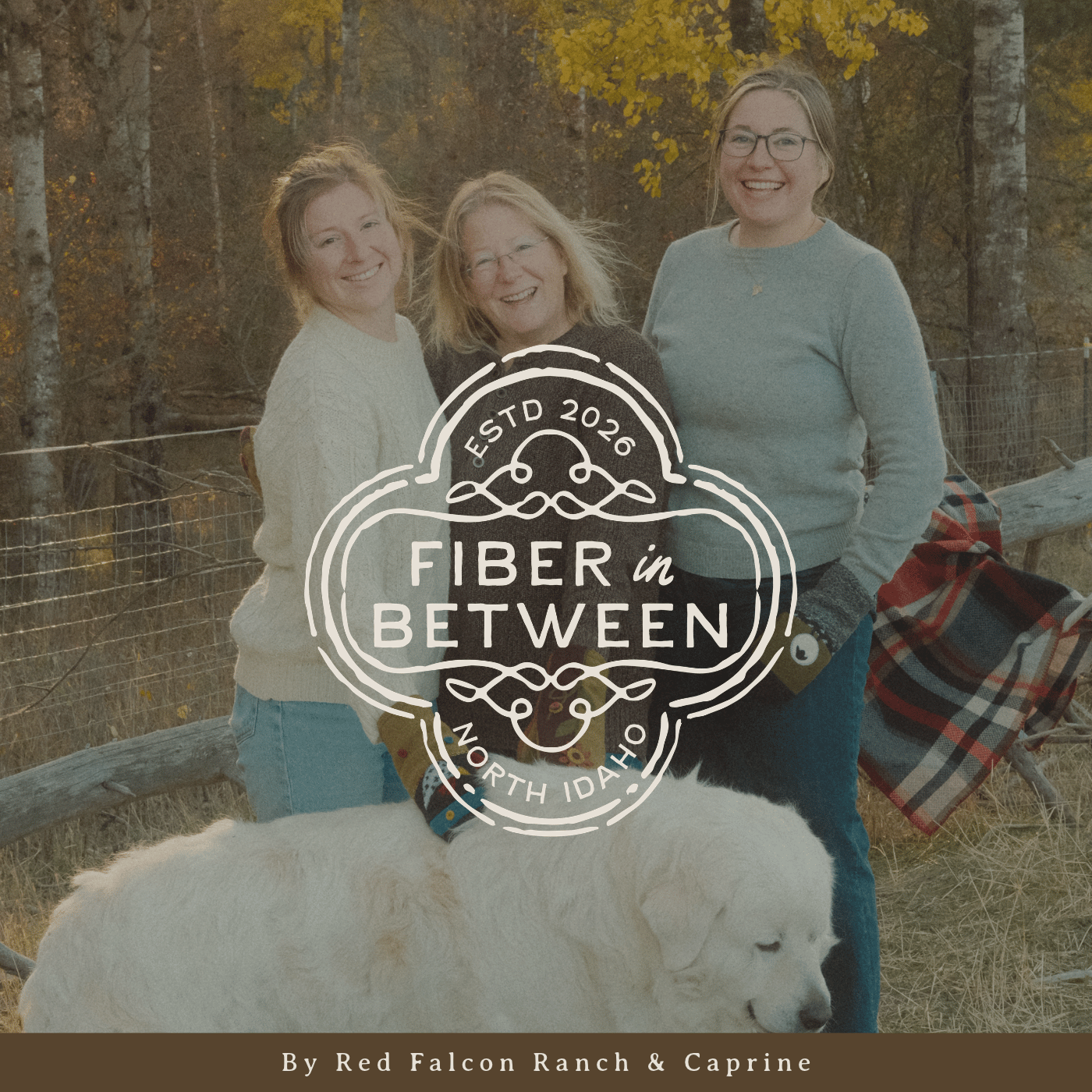
Hello and welcome to Fiber in Between. I'm your host, Sarah, and with me is Rachel
[00:00:14] Speaker B: Angela,
[00:00:15] Speaker A: my mom and sister. And today we are doing what we're commonly known for doing, which is rabbit holes. But this episode is in the form of a Q and A type panel. So. So a couple weeks ago, Rachel put on the Red Falcon Ranch's Instagram stories a question box for any questions people may have. And so we're going to be answering them. A lot of them are of the similar sort, but we're just kind of going to be going through them and answering them. So
[00:00:43] Speaker C: hence Q and A.
[00:00:44] Speaker B: Take it from the top, Sarah.
[00:00:47] Speaker A: Okay, let's start it off with how many goats are in your herd?
[00:00:50] Speaker C: Okay, we'll start off with that. I'm just going to add in.
A lot of these questions are answered in previous episodes, but that's where we go deeper into more of the subjects. So this is just going to be kind of a flyover of just rapid fire answering.
[00:01:06] Speaker A: Like a panel.
[00:01:07] Speaker C: Yeah. Just
[00:01:08] Speaker A: imagine it as if you're the crowd, the listener, and you asked these and we're answering them. That's what this is.
[00:01:15] Speaker C: Repeat the question.
[00:01:16] Speaker A: How many goats are in your herd?
[00:01:18] Speaker C: So that is kind of a fluctuating number because now we just bred a bunch. So we kind of technically have babies being made inside, babies on board, goats on the ground. We have 79, and they are all named and we can tell them all apart. And people have brought up a good point, because I often do when I let the goats out, I name a bunch of them as they go by. People. People are like, well, how do we know you're not making up names as they walk by? Personally, I think they're all very unique names. And if I was able to come up with those names on the spot, that's even more impressive than already knowing the names, because it's not like Bubble Squeak and Poppy are running by. It's Tova and Eliana and all these unique names so that you don't hear often. So, yes, there's 79.
[00:02:13] Speaker A: And what's the split between girls and boys?
[00:02:16] Speaker C: So that we definitely have more girls than boys. And the girls you most often see in my videos, they're the ones that we let out in the morning because our dad lets out the big boys on their pasture. So we have. We have 10 big boys, and the big boys are the intact males.
And then we have four. Well, we have six big wethers, and wethers are neutered males.
So we're at 14 bucks. There. And then we have a bunch of baby boys, so we have around 20 boys.
And they all are separated from the girls because we don't want to have babies happening all the time. And we don't keep bucks and does intermingling all the time because that ends up creating a lot of unnecessary drama.
So we keep everybody separate.
And then we have around 60 does.
[00:03:07] Speaker A: And then do the dogs, do they have access to everything? Are they only with the does? How come all the time?
[00:03:14] Speaker C: I do get that question asked a lot. How come like do the guard dogs also protect the bucks? How are things set up? So our property? Because then another common question is how much land do you have? So our property is 20 as a 20 acre rectangle.
So it's. It's really pretty simple. That way you can see pretty much everywhere except down into the dip.
And so that's a little bit of a valley that's in the doe pasture. But otherwise you can see all the corners and there's hardly no trees because where we live used to be forested. Used to be a beautiful cedar Forest about 100 years ago. And then they completely deforested it, made it into an alfalfa pasture, which has been for decades. So this land has been stripped and plowed and it's actually very sad. So we're working on revitalizing it and re doing regenerative planting here. So we'll actually be adding seed this week to a Gabe Brown mix to revitalize the pasture. To make a short story long, so just to give you guys an idea of that, and so then we have two pastures each, seven acres. The does have one, the bucks have the other. When the grass is growing, well, then the horses go out there with the bucks and they share that pasture. And then you have co grazing with which is actually really great because then the horses eat all the goat parasites and then goats eat all the horse parasites because parasites are species specific. So it's like a natural dewormer.
So then you have the horses and the bucks on their side and the does on the side you most often see in my videos.
However, the dogs cannot easily get over to where the bucks are because it's all fenced off. So the dogs mainly stay with the does because they are the most vulnerable. They have the young and the old and the infirm. And so the dogs stay with them.
And the bucks, there's not many of them and they have their big horns, so they kind of got a bit better system of defense that way.
And because we don't have A lot of trees and whatnot. A predator can't really hide. Well, the dogs will know what's there there, especially during the daytime. So if anything were to happen, either we would see it, or the dogs would see it and. Or the animals would let us know, and then we'd be able to help. Because then at night, at night, the bucks are locked up, the does are locked up, everybody gets locked up in their own pen. And the bucks have their grizzly bear gate and everything.
And then we open up, we close the driveway gate so that we're completely perimeter fenced, we close the driveway gate, and then we open up three different gates for the guard dogs so that they have access over the whole property, the whole 20 acres. They can perimeter check and guard all night long because that's usually when predators are at the most active.
So hope that answers that question and how that works. A lot of farms use jump holes, which are holes in the fence that the dogs can jump through and easily get from pen to pen to pen.
We've tried that. It works great for the dogs. Unfortunately, it also works great for the goats. And a lot of the goats have figured out to jump in and out, and we do not want any unsolicited breedings happening.
So that is, we really cannot use jump holes in that respect. But since the dogs can pretty much see everything, especially during the daytime and we're out and about and active on the ranch, too, that the bucks really don't need a dog with them. They are okay by themselves with the dogs just on the other side of the fence and us watching. And then at night, everything's locked up and the dogs have free reign over the whole property.
[00:07:15] Speaker A: Great.
[00:07:16] Speaker B: Excellent.
[00:07:17] Speaker C: If that makes sense.
[00:07:19] Speaker A: Good job. And I have a question. I haven't read through all the questions yet, but this is another one that comes up. Go for it. Sarah, have you ever heard of rotational grazing? Why do you only have two pastures?
[00:07:28] Speaker C: That's a great question. Believe it or not, I have had.
I have heard of rotational grazing because I went to university and I have a minor in rangeland management and ecology, where I learned all about that and learned rotational grazing. I learned stocking rates. I learned carrying capacity. I learned many, many things.
And the reason we have just two pastures is mainly because when we first moved here, mom got diagnosed with cancer like, a year or two later.
So we are years behind in our. In what we've been wanting to do. And you and I went to school during that whole time, so we've only been home two years. Even though we've lived here eight, you know, so we're behind in many ways, and we're catching up to that this spring.
We've partnered with nrcs, which is the natural resource, Soil and Conservation organization here in the United States.
And they work a lot with farms and how to better improve farms with land.
We are working with nrcs, which is we're getting the right seeds that we have a biodiverse seed that we're planting out there to revitalize the soil.
And we're working on a big tree project to replant a bunch of trees to get the water table back up. We're having new fencing done this coming spring so that we can truly begin to do rotational grazing.
[00:09:04] Speaker B: And let me interject there, because we do have perimeter fencing, which took us an entire summer, and it was thousands of dollars. And it really comes down to time and money.
[00:09:15] Speaker C: Yeah.
[00:09:15] Speaker B: And. And when we bought this place, there was no infrastructure here.
So we had to do the monetary investment and the time investment, just a perimeter fence. And then we got one segment done to divide it down the middle to keep the boys and the girls apart. And then, like you said, I got cancer. Cancer is expensive.
Fencing is expensive. And it really comes down to money.
And if you talk to anybody raising any livestock, fencing is a huge expense. And you do what you can with the budget that you have,
[00:09:51] Speaker A: and it depends on the animals you keep, because there are different programs that will help you put fencing up. However, we raise goats, and if you know anything about goats, they need good fencing.
[00:10:03] Speaker B: Yeah, they'll go through fence. I know. Test
[00:10:05] Speaker C: it. I know. Like our neighbors. Our neighbors have cows, and they just have two strands of electric up.
Cows are so easy. And
[00:10:14] Speaker B: horses would be like that, too.
[00:10:16] Speaker C: Cows and horses respect fencing so well, you just throw a couple lines of electric up and that's it. Goats, you cannot do that.
[00:10:24] Speaker B: Goats are escape artists. Like
[00:10:25] Speaker A: cows and horses. They're athletic. Of course, you'll have your exceptions where they're gonna do things, but on average, they'll stay put. Goats, it's the exception that they will stay put.
[00:10:34] Speaker C: You have to make everything Fort Knox. And even then with angora goats. Angora goats have horns.
So you can't just use any type of fencing. You got to use fencing that they're not going to easily get their horns stuck in. And then they also have hair. They're covered in hair. So a lot of people use, like that white mesh stuff. We tried that one got caught in it over a wasp nest. I'm shocked. She we had to go in there and save her. I got stung over 20 times. The poor goat got stung over 40 times. We learned that. And they're never to use that white mesh. No,
[00:11:09] Speaker B: do not use white mesh electric fencing with horned animals. Because in that particular case, Rachel's talking about, we. It was September. They were sheared. So she was naked. We did not know that there was a ground nest. We had just
[00:11:25] Speaker A: moved to that place.
[00:11:26] Speaker B: We had just moved there. We were renting. It was shortly after we'd moved out here to Idaho. And there was a ground hornet nest. We didn't know about that particular place.
She got her horns not just stuck in that fence. She got that wrapped around her horn multiple times.
So we were. Rachel, Sarah and I were all running in there, cutting off a little bit and then running away. And we were all getting stung. They were getting inside our clothes and we'd run back and we'd cut some more. That poor goat had over a hundred hornet stings.
We took her to the vet so that she could get the proper meds on board to save her life from all the toxins.
[00:12:09] Speaker C: She did survive. She did. And we survived because we got stung. I got stung over 20 times.
[00:12:14] Speaker B: So many times.
[00:12:15] Speaker C: But that's just an. We learned. Okay, we're not gonna use.
Having horned animals makes fencing a lot more difficult.
[00:12:24] Speaker A: Why don't you just cut off their horns? They're dangerous too, aren't
[00:12:27] Speaker C: they? That's another popular question. Why do they have horns?
So any animal, I mean, just think about it, Just think about it. If any animal is born with horns, there's probably a good reason why and why they should keep them.
So I am very much against anything being dehorned. There are a lot of animals out there that are polled
[00:12:53] Speaker B: naturally.
[00:12:54] Speaker C: Naturally dehorned. You know, that's just cold and evolutionary. It
[00:12:58] Speaker A: doesn't mean they. The human naturally dehorns them. It means the animal doesn't grow horns.
[00:13:03] Speaker C: They've developed that to where they don't grow horns anymore. But I believe anything that naturally has horns should probably keep their horns. And regarding our Angora goats, they are in a thick fleece during the heat of summer. How do they stay cool? One of the main reasons is through their horns. Their horns act as a built in air conditioning unit, which a lot of people in Europe don't understand.
So it acts as a built in cooling system in their horns. And the way it does that is because there's an active blood supply through their horns, which is why. Another question, do we trim their Horns only if it's like growing into their head and we trim a little bit off at a time because there it's that blood supply. And you do not want to hit that blood supply, otherwise they will bleed to death.
[00:13:54] Speaker B: It's like a quick in a dog's toenail.
[00:13:56] Speaker C: Yeah, you don't want to hit that because then you got to take them to the vet and it's a whole ordeal,
[00:14:00] Speaker A: get it cauterized.
[00:14:02] Speaker C: So their horns, because of that blood, have a passive heat exchange with the air around it. So when it's really hot out, the hot blood is in the horn has a passive heat exchange with the air around it and goes back down into the body cooler.
So that way they're able to stay cool in the summertime.
[00:14:26] Speaker A: So that leads me to my next question.
Why are Chronicles horns so big?
[00:14:31] Speaker C: So their horns never stop growing.
And as you can probably see from a lot of my videos, the bucks have much bigger horns than the does.
And that's just simply due to a gender thing. The bucks grow them much bigger because then, you know, it's like out in the wild, the bigger the horns, the more impressive they are to the doe.
[00:14:49] Speaker B: The testosterone.
[00:14:50] Speaker C: The testosterone. So there. So both does and bucks, they never stop growing. But the bucks do grow much bigger than the does.
And so the does each have their own unique horn sets. And that is one thing we keep in mind breeding wise, because we don't want them too low, we don't want them too high, you know, we don't want them too narrow.
All for various reasons. And so horns are definitely one thing we keep an eye on. Yes.
[00:15:17] Speaker B: So also explain that weathers, once they're weathered and they don't have that testosterone flowing through their body, they, their horns are not going to become as impressive as an intact buck.
[00:15:28] Speaker C: It's going to end up growing like a doe then.
[00:15:30] Speaker B: Yeah, I
[00:15:30] Speaker A: mean, it's still bigger.
[00:15:32] Speaker C: They're going to grow in the same direction as a buck, but they're now going to grow at a rate similar to that of a doe.
[00:15:38] Speaker B: Right.
[00:15:39] Speaker C: Because they don't have that testosterone, so
[00:15:41] Speaker B: they won't have that massive horn set. Except in the case of Chronicle, who was weathered when he was what, 4 years old? Yeah,
[00:15:48] Speaker C: because normally we weather, we're able to tell. So a weathering is neutering.
And we weather bucks that we do not think should be bred. We do not, for whatever reason, we don't think they should pass on their genetics. And we have very, very high standards regarding that because there's I Think a myth regarding weathering that it's like a bad thing or a taboo thing. It's actually a great thing, weathering your goat, because then they end up living a much longer life, a much healthier life, because they don't have all those raging hormones going through their body every fall. And they're not headbutting and doing all of that stuff. And it enables them to make much better mohair, actually. So if you're looking to have a herd of Angora goats, I highly suggest getting wethers. They're very chill, undramatic, not that the others aren't, but they don't have any hormones raging through them. They and everything gets poured into their mohair. Then rather than
[00:16:50] Speaker B: such good goat citizens,
[00:16:52] Speaker C: rather than making babies or anything like that. They
[00:16:54] Speaker B: have such a nice personality too.
[00:16:55] Speaker C: Yeah. So a weather will not have as big a horns as a buck unless you weather them late. Like we did Chronicle because we were going to breed Chronicle, but then he ended up getting very aggressive to the other goats and started getting aggressive towards us. So we had the vet out to weather him. And good thing we did because the vet said, come look at this. And we came and he said, he has testicular cancer. So if you would not have done this, he would have died. And that may have been why he was becoming so aggressive, was because of that. So Weathering Chronicle actually saved his life and that is why his horns are so big, is because he was weathered late.
Yes.
[00:17:35] Speaker B: I think we should talk to our listeners and explain to them the difference between horns and antlers.
[00:17:42] Speaker C: Oh, horns and antlers. So wild animals like moose and like ungulates such as moose, elk and deer have antlers. And antlers are not permanent fixtures on the body. They are shed yearly.
So every year those animals have to grow that whole.
That whole rack, essentially, and in doing so actually develop temporary osteoporosis because all the calcium is leached from their bones and put into making the antlers, only for them to shed them and then grow them bigger the next year.
The goats don't do that. The goats horns are permanent. They're in the skull like they're made out of keratin. And they just continue growing. They don't shed them, nothing like that. They grow, grow until they die.
[00:18:37] Speaker B: And just to let everybody know that's listening, Rachel speaks from a position of academic knowledge here because she does have a Bachelor of Science degree in Wildlife Resources and has studied this extensively.
[00:18:50] Speaker A: Then why don't you have rotational pastures?
[00:18:53] Speaker C: Right. Why don't we have rotational anyways
[00:18:54] Speaker A: Next question.
[00:18:56] Speaker B: Time and money.
[00:18:58] Speaker A: Your pasture out there is just a thing of dirt, you know.
Sorry. Anyway, how come you don't run the weathers with the does?
[00:19:05] Speaker C: That's simply a personal choice we've made because we have so many and like a lot of farms, when they have like 10 goats and that's it, they'll just keep the weathers and does together because they have like five does and two weathers. Like it's, it's no big deal. But we have like 60 does out there. And if we were to put our weathers in there, I think it would be hardest on the weathers because they would still have that male presence about them. And all the does going into heat would want the weathers. Oh,
[00:19:41] Speaker B: they would pester them so badly
[00:19:43] Speaker C: and it would just. It would cause a lot of unneeded drama. And the weather have
[00:19:48] Speaker A: like £100 on all the does.
[00:19:50] Speaker C: Yeah.
[00:19:50] Speaker A: So they take up quite a bit of space. They
[00:19:52] Speaker C: would. So it keeps
[00:19:53] Speaker B: the numbers more balanced too.
[00:19:55] Speaker C: Yeah. Keeping
[00:19:55] Speaker B: all the parts together.
[00:19:56] Speaker A: Speaking of weight, what is the weight distribution? Like, what's the average weight of a dough a kid when it's born a buck a weather?
[00:20:04] Speaker C: So I have noticed that we definitely have the biggest angora goats in the country, probably the world.
Ours are huge. And I say that seeing and meeting others, we have the biggest
[00:20:21] Speaker B: because we used to show goats, so we would, we would see other people's herds too,
[00:20:25] Speaker C: and getting other people's goats. We definitely have the biggest. And I don't know why. It's not like we're, you know, it's not like they're all eating grain 24 7. Only the oldies get grain. So I don't know if it's all the love or what, but ours are huge. I
[00:20:42] Speaker B: think that comes down to a lot of preventive care too, maybe
[00:20:45] Speaker A: nutrition,
[00:20:46] Speaker B: nutrition, preventive care. We make sure that we're not dealing with any coccidiosis in the babies, that they can gain weight as quickly as we do
[00:20:56] Speaker C: feed.
[00:20:56] Speaker B: We creep feed, which
[00:20:58] Speaker C: is where we set up a feeder when they're babies that only the babies can get into so they can get grain 24, 7 until they're like
[00:21:07] Speaker B: 7
[00:21:07] Speaker C: years old.
[00:21:08] Speaker B: And we test our hay so that we're not feeding hay out of ignorance that might be very look beautiful but be very low quality. So we're testing because
[00:21:17] Speaker A: they need a lot of protein because hair is protein
[00:21:20] Speaker B: and we provide high quality minerals. Free choice all the time in a loose form, not a block that they have to bite off. Of so I think a lot of it just comes down to preventive care and heading off problems before they start.
[00:21:35] Speaker C: So.
[00:21:36] Speaker A: Yeah. Based on. Answer my question. How much do they weigh?
[00:21:39] Speaker C: Based on that, Our. Our biggest goat is Al. He's a weather and he weighs consistently 225. 225lbs when we weigh them twice a year. Because we weigh our goats, this isn't like eyeball basing it off of. We weigh them every shearing season. And Al weighs 225 pounds. He's our heaviest. And then the bucks generally weigh between 170 and 225.
All of our big boys and then our does weigh between like 110 to 180 pounds. So the does are a bit smaller, a bit lighter. You average for our does, I'd say is 140. 150 is our average doe weight. And then babies when they are born are usually about £5. A big baby is £10 and that's really too many. We
[00:22:38] Speaker A: have had a 12 pound one. His name was Toblerone.
[00:22:41] Speaker C: That's
[00:22:41] Speaker B: really
[00:22:41] Speaker C: too big. That's too
[00:22:42] Speaker B: big. That's hard on those mommies.
[00:22:43] Speaker C: And then
[00:22:44] Speaker A: Vosh was £10.
[00:22:45] Speaker C: The Guinness was £10. What
[00:22:47] Speaker A: was Vos?
[00:22:48] Speaker C: I don't think he was 10.
[00:22:50] Speaker B: I don't know. But then we have little Loxley who was a pound and a quarter.
[00:22:52] Speaker C: Loxley was born a pound and a quarter, which is way too light. So average baby weight is five pounds.
And then they grow very like, they gain quite a bit of weight in their first and the
[00:23:04] Speaker A: boys grow quicker than the girls. And then my next question is.
I just forgot it.
[00:23:12] Speaker C: Well, they.
[00:23:12] Speaker A: What's the gestation period?
[00:23:14] Speaker C: The gestation period for our goats is. Well, for any goat is five months,
[00:23:19] Speaker B: 150 days
[00:23:21] Speaker C: roughly. And
[00:23:22] Speaker A: give or take.
[00:23:23] Speaker B: Give or take a couple days.
[00:23:24] Speaker C: Yeah. Five days before or five days after.
[00:23:27] Speaker A: Okay. And then I know there's more questions that can lead into that, but how come you sheared your goats so close to winter? They're going to be really cold.
[00:23:36] Speaker C: So if anybody has been. Who? Anybody who's listening. If you've been watching my videos, you'll already see how much mohair they have grown since I sheared them in September.
So mohair is the fastest growing fiber on the planet, growing at the intense rate of an inch per month.
And they begin growing their mohair the minute they are born. They are born with mohair. So I have to shear them six months after they're born and sometimes even sooner because they're Growing in so fast.
And they grow mohair all the way because on average, goat lifespan span, at least for us, is into their teens.
So it's like that of a dog, essentially. And they grow mohair that whole time. It definitely does slow down. Once they get into like 11, 12, 13, 14 years old, it definitely does slow down. Then I only share them once a year because then going into winter, I give them what we call a diva cut, where I leave like a big cape of their mohair so they kind of go in with a winter blanket.
But like, I sheared everybody in September because I have to shear them twice a year because they grow mohair so fast. So I sheer them in March and September. Those are the months we choose to shear based on where we live because we live in the Northern Rockies.
And if I was to shear April or November, then, you know, that's giving less time heading into winter. And if I was to do February or August, again, that's also shearing in the winter. So March and September are the mildest months for us to shear regarding winter, because that's the season we're working around here.
[00:25:17] Speaker B: Right. So down in Texas, they're more like January and June.
[00:25:20] Speaker C: Yeah, it doesn't matter because they're not dealing with winter.
[00:25:22] Speaker A: And as I'm just going to put a little note in here. As for the heat, the angora goat originates from Ankara, Turkey.
They're used to the heat. So even if they have, you know, a few inches of mohair on them, in the heat of summer, they're hot, but they're okay
[00:25:38] Speaker C: because mohair is a natural fiber. It's breathable.
So it's not like the goats are covered in polyester or nylon. Like, it's a breathable fiber. And so it has temperature regulating abilities. Plus they have their horns, which keep them cool as well.
So I shear them. Why do I shear them twice a year when the mohair is six inches long? Because that is the longest staple length a mill can work with for mohair. Otherwise, then the lock is too long and it gets wrapped around the.
[00:26:11] Speaker B: Wrapped around the rollers as they're clipping
[00:26:13] Speaker C: it. So it has to be a maximum of 6 inches long,
[00:26:16] Speaker B: no more than 6 inches.
[00:26:18] Speaker C: And since I shear them in September. And if you've been listening, what should the mohair length be on the goats right now?
If you answered 2 inches, you'd be correct. Now hold 2 inches. That's a good bit of mohair on the go heading into winter. So they already have a good solid winter coat. They're fine. Okay. I didn't steal their winter coat.
They're growing a new one and they already have it.
[00:26:49] Speaker A: So I have a couple, couple shearing related questions.
Do you bathe them? How do you get them clean?
[00:26:55] Speaker C: So we do not bathe our angora goats because you have to be very careful washing the mohair while it's still on the goat because it can felt so wet mohair that gets agitated, will felt. And then you've basically ruined the fleece on the goat.
[00:27:13] Speaker A: Well, I went, well, that could be a case. My answer to that would be, it's a ton of extra work that's unnecessary and,
[00:27:19] Speaker B: and it's the wrong time of year. You're not going to hose. Would you hose down your pet dog outside at the end of March in the mountains or at the beginning of September, the nights get down to 40 degrees and the days are not necessarily
[00:27:33] Speaker A: that long. They're covered in hair and it. But I also want to add natural fibers are pretty self cleaning. So it's not like they're disgustingly gross. They're. They're a clean animal. And then once you shear the mohair and you get it processed, then you wash it. You wash it after it's cut off.
[00:27:50] Speaker B: And nature's evolved to help take care of that too. Like sheep have grease.
[00:27:55] Speaker C: No, sheep have lanolin.
[00:27:56] Speaker B: Sheep have lanolin.
[00:27:57] Speaker A: Sheep produce wool, wool has lanolin. Angora. Goats produce mohair, mohair has natural grease.
[00:28:05] Speaker B: And those protect the fibers from the elements, from the rain, from the dirt building up. We do tend to get more dirt next to the skin skin here in this drier climate than we did when we lived in Minnesota. So we have a dog blower, like at the groomer to blow out the fleeces and blow off as much dirt and dust next to their skin because that dulls the blades when we're shearing.
But as for a bath, no, we don't give them a bath.
[00:28:32] Speaker C: But some people do. Like before a show.
[00:28:35] Speaker B: Yeah, before a show
[00:28:36] Speaker C: you got to be very careful.
[00:28:37] Speaker B: You have to. And they're not shampooing them. They're just wetting down the mohair. They're not drenching it. They're basically just misting the mohair. Because that makes the curls pop. Yeah. And you want that in the show ring.
[00:28:49] Speaker C: Yeah.
[00:28:50] Speaker B: So it's not necessarily a bath. It's just, it's just pre show grooming.
[00:28:57] Speaker C: Go ahead.
[00:28:58] Speaker A: I'm gonna switch it to. How do you come up with all the names for your animals? They're so unique. Do you have a theme. What's the.
[00:29:05] Speaker C: Yeah, so that is a very interesting. That is a very common question.
So basically we have a master name list. We have it on paper and then we each kind of have our own name lists that we have on our phone so that when we see or hear a name that we really like, we'll write it down and add it to the name list.
I don't tend to stick with themes. I'm not against themes by any means, because like with our livestock, guardian dogs, we totally have a theme. A frozen Scandinavian theme, which we works out well because it fits them perfectly and it's kind of fun having that. That going along. So like, our next guard dog will be a female and her name will be Elsa. So then we'll have. We'll have Olaf, Sven and Elsa, you know, so that'll be fun. And because Thor most likely won't be here. But like, for our goats, I don't really tend to stick with a theme because the goats each have such unique personalities and looks, and I want that to be represented. I don't want them to boxed in by a theme unless I already have a name picked out before they're even born. And that it's kind of a link with either their mom or their dad or if it's something I'm reading, like. So, like take Irish Rose, for instance. Irish Rose was born on St Patrick's Day. Therefore that influenced our name for her. And then she had Guinness. And we already said if she has a black baby or a brown baby, a boy, we'll name him Guinness. And it worked perfectly for that. But then, like, we'll have others where we'll name them and the name just doesn't fit. It doesn't stick. So then we got to figure out a different name that'll. That'll fit better.
Sometimes their genders change, so then we have to find a different name. So like Pendragon was Odette for a few days before mom and Sarah realized he. That he really wasn't Deno dead.
[00:31:09] Speaker B: He was a Pendragon. He
[00:31:10] Speaker C: was a Pendragon. So it.
[00:31:12] Speaker A: And that's because we were watching Merlin during that time.
[00:31:15] Speaker C: It really honestly, we also
[00:31:17] Speaker A: had Gwain and Percy.
[00:31:18] Speaker C: And
[00:31:19] Speaker A: this fits them because they were such adventurous, still are little kids and their nights at the round table. And I also want to add the personality that I. I have found that the personality a kid shows a kid is a baby goat. Like the first few days. That is who they are at their essence. So Gwen and Percy very Adventurous voge, super cuddly. That's
[00:31:41] Speaker B: who they are. And as far as themes, we don't say this is the A year or the B year, and everything has to be a name with that letter. Sometimes with twins, it's fun to do kind of matchy matchy names. Like, we had a boy and a girl born one year, and they were Christopher and Robin for Christopher Robin. And we had Pocahontas, and she got her name because she was born early, early before we were out there. And she had already made her way across the barn, and we found her over there, separated, far from her mom. So she was Pocahontas. So sometimes her
[00:32:17] Speaker A: sister was named Willow, after the grandmother willow tree.
[00:32:20] Speaker C: Yeah, I just we by theme, I guess I should say we don't do the whole ab. Like, this year is the year of. You know, we're gonna all use the letter F. You know, I don't do that because you're dealt with a finite amount of names and. And
[00:32:36] Speaker B: they might not fit the animal's personality. And it comes down. They all have personalities.
[00:32:40] Speaker A: And Sophie has a set of twins named Eowyn and Arwen from Lord of the Rings. And Arwen is a black doe and Eowyn is a white doe, and they're both incredibly regal, and it just fits them perfectly.
[00:32:53] Speaker C: Yeah, yeah.
There we go.
[00:32:56] Speaker A: Why Scandinavian for the dogs?
[00:32:59] Speaker C: Because we started out, our first guard dogs were in reality Fluffy and Brook.
Fluffy was supposed to be Forte, but Sarah just kept calling him Fluffy.
[00:33:09] Speaker A: And Forte means Italian. It means strong in Italian. And the breed's Italian Maremma. That's why mom wanted to call him Forte, but he was really Fluffy, and I was like, you guys can call him Forte, but I'm going to call him Fluffy. And then they all did. So
[00:33:21] Speaker C: if Sarah nicknames any goat, that ends up becoming the goat's name, unfortunately. So that's always a constant battle.
Anyway, it became Fluffy and Brook, and we just really liked the name Brook. That's. That's where Brooke came from. And then we got Thor and Bear because we thought Thor is such an awesome name for a guard dog. And then Bear is like, such a classic name for a guard dog. And
[00:33:47] Speaker B: he was built like a bear.
[00:33:48] Speaker C: And. And then Frozen came out. And so we're like, wouldn't it be cute if we, like, started using those names for guard dogs? And so then we had Olaf, who fits his name perfectly, and then Sven, who fits his name perfectly.
So that's just kind of where we're going with the Scandinavian names. They're just fitting them perfectly. So our next one will be a girl, and her name will be Elsa.
[00:34:12] Speaker A: And then do you train the dogs? How do they know how to do their job?
[00:34:16] Speaker C: A lot of people ask that question, and I give them the same answer every time. I don't do anything. Formal training with them, everything they know, from shifts to attacking predators, to being with the goats and figuring themselves out, that's everything. On their own, they do that. They figure that out. The only thing I teach them are party tricks like sitting, rolling over, laying down. You know, when we get them as puppies, we facilitate their behavior, Obviously. We don't just throw them out and be like, okay, let your DNA do the work. No, we do facilitate and be like, no, don't chase the chickens.
[00:34:52] Speaker B: Yeah, we set boundaries.
[00:34:53] Speaker C: Don't eat this cat that. Don't chew on this goat's horn. But regarding how they guard and their behavior that way, that is purely them. I'm not out there micromanaging, saying, okay, Olaf, your night shift. Thor, your day shift. Okay, you're gonna do this, you're gonna do that. I want you to keep an eye on the sky so that no birds of prey come. You know, I'm not doing that. That's all them.
[00:35:15] Speaker B: And we have a podcast that dives deep into. We have
[00:35:18] Speaker C: an episode on this podcast.
[00:35:21] Speaker A: Yeah, there's an episode a couple. Couple episodes back. If you want to learn more about the guard dogs and everything about them, it's quite interesting. So if you're interested in them, I recommend giving it a listen.
So I'll do some more questions that we can just, you know, fire out. So amazing content. Do you and your sister plan on working the family ranch long term?
[00:35:42] Speaker C: I can't answer that. I have no idea. This wasn't a part of my plan. Mainly because I don't have a plan. I'm not a planning person.
So I, I'm. I'm definitely not a career driven person, obviously. You know, I'm just kind of go where the wind takes me. And the wind took me back home, mainly because mom was dealing with cancer. And so the ranch took a real nosedive into that because there was nobody to. To do anything. Like there wasn't any sales or anything happening. It was. It was stagnant. And so Sarah and I came home to help revamp the ranch. And in doing so, we now have over half a million people involved in it, which is absolutely insane. And
[00:36:27] Speaker A: we're sending orders all over the country and the world.
[00:36:30] Speaker C: So nobody foresaw this happening. Two Years ago. Nobody foresaw that. So I honestly, I have no idea what the next two years will bring. I really don't. So I, I, I don't even know.
I do have a bachelor's degree that I can probably use if needed or wanted. But
[00:36:49] Speaker A: Rachel gets job offers all the time for really cool jobs all over the world, just through the people she meets. So she needs more lifetimes.
[00:36:57] Speaker C: Yeah. I mean, there's so many things I'd like to do. I'd love to, you know, be an archaeologist or go work at a castle or go work on rewilding projects over in Europe and be a smoke jumper and I mean, there's so many things I want to do, but there's a lot happening on the ranch right now, and this is where I'm needed and this is a perfectly fine place to be.
[00:37:17] Speaker B: And how about for you too, Sarah?
[00:37:19] Speaker A: Great. Thank you for asking. So, yeah, same as Rachel. I didn't know I was going to be here. You know, I thought it was just going to be the classic, you know, you go to university and then you go away,
[00:37:30] Speaker B: you go get a job somewhere.
[00:37:32] Speaker A: And I hadn't really, you know, completely fallen for that trap because I've always kind of made my own way within that. So I paid my way through school with my own online yarn shop, which I guess I should have kept going because a lot of people want yarn now. And I'm like, well, where were you five years ago anyway?
[00:37:49] Speaker B: And let everybody know you were Pine Rose and Company. And you had a huge following, very engaged following. And you had really awesome yarn products.
[00:37:58] Speaker A: I did. Thank you.
That will be interesting to bring into the future because that's something I'd like to work on. So I like doing entrepreneurial things. Always have. And did I know I was gonna be doing this? No. Am I happy to be doing it? Yes. Depends on the day. Yeah, it does depend on the day. I get overwhelmed quite a bit. There's a lot happening this season. The growth has been pretty much indescribable. A lot of
[00:38:24] Speaker C: growing pains. A
[00:38:25] Speaker A: lot of growing pains in amazing ways. But it's, you know, you see the highlights. Well, Rachel shares the not so much highlights too. But it's a way of life that is incredibly rewarding and equally challenging.
[00:38:40] Speaker C: It's very unique
[00:38:41] Speaker A: and I'm up to task. I think it's pretty. A pretty.
[00:38:45] Speaker C: Sarah's up to task now because I got her jerky
[00:38:48] Speaker A: and sourdough bread.
[00:38:49] Speaker C: Yeah. So her protein and carbs are back up.
[00:38:52] Speaker A: Yeah. So I don't know, I'm excited. I want to add yarn to the shop. I think having a brick and mortar yarn shop in our town would be really fun because it doesn't have one. I'd love to facilitate classes and workshops. And one of my dreams before I went to school and before the ranch was known around the world was having like a farm space with a big barn that could be open for venues and having fall fests and Christmas markets kind of reminiscent of Europe, European ones.
And host retreats and have like a bunch of little hobbit holes and Airbnb those. And I still kind of have that. And I want to have bees. And it'll probably be in a little bit of a different capacity, but we have a get a lot of requests and questions in the question box I have here of are you gonna ever host people? And that is something we would like to do in the future, but it's like almost like a dream.
I don't know how feasible it is at this time. Certainly not because we have the guard dogs to consider our own capacity. We're quite stretched thin between everything we want to do as we grow and something we'll work towards. But I can't promise when that will ever be or what that will look like. But I do think that would be really fun. And I want to add yarn to the shop. Hoping to that in the new year. This podcast itself was something I've been wanting to do since April 2021.
And do we have time to do it? Not really, but we're making it happen.
So in between our shop drop this Friday and which is November 2026, because this episode will be around for a while and chores tonight, we're squeezing this recording in and just doing it.
[00:40:29] Speaker B: And I've got a roast in the oven that I gotta go tend to before too long.
[00:40:33] Speaker A: Yeah, there
[00:40:34] Speaker B: are lots of hats here.
[00:40:35] Speaker A: Rachel and I will be here indefinitely.
And then it also brings up another question. Do you ever leave? Do you ever travel? Do you ever get a break? So.
[00:40:42] Speaker C: So that's where we really have to make it a priority because if we didn't, we would never leave.
[00:40:49] Speaker B: We'd get burned out.
[00:40:50] Speaker C: And so basically, with mom's cancer, with mom's cancer, we made doing things a priority. And by doing things, I mean traveling. Because there is a real mindset that traveling abroad, like traveling to Europe, is kind of a once in a lifetime thing. And it's kind of like a break the bank thing.
That's a total myth. It's actually cheaper to travel to Europe than it is. It
[00:41:19] Speaker A: depends on how you travel. It
[00:41:21] Speaker C: is if you go Michelin
[00:41:22] Speaker A: star and
[00:41:23] Speaker C: I don't. But basically, basically it's cheaper to travel to Europe than it is to Maine or Vermont.
[00:41:30] Speaker B: Yeah, that is true, because my sister and her daughter recently took a trip to coastal Maine and. And it was three times as expensive as when we take some time over to England or something.
[00:41:42] Speaker C: And that was just a regular trip. Yeah.
[00:41:44] Speaker B: And they didn't even do anything special.
[00:41:47] Speaker C: So getting into that, when mom got through cancer, Sarah and I were about to embark on a three month backpacking trip. And we had mom come for the first two weeks to England with us. She fell in love. And we decided then and there that we're gonna make this a yearly thing to where we all go abroad together every year, because otherwise we never go. We never. We'd stay at the ranch all day. There's
[00:42:13] Speaker A: never free time.
[00:42:14] Speaker C: And when
[00:42:14] Speaker B: you guys were growing up, we didn't take vacations. We
[00:42:16] Speaker C: never took vacations because somebody always has to stay back and take care of the animals. That's just the way it is. That's always the way it is. And it's not just like a dog and a cat. It's over a hundred animals that you have to take care of. And that doesn't even include all the special needs ones and all the different, you know, routines and whatnot. And so we found that there. That there's a place called Trusted House Sitters where you can put, you know, your house, your ranch or whatever up there with all the things that need to be taken care of and people will come for free to stay at your home and take care of your animals. And so we've utilized that which has been an absolute game changer for us.
So we have, we are now, at least once a year, we go to Europe for a week or two just to take a break. And then somebody's here to take care of all the animals, keep us up to date. They come a couple days early so we can get them all trained in so that the guard dogs get to know them. And that has been an absolute game changer for us.
So.
[00:43:19] Speaker B: And we decided when I was going through cancer, when you look death in the face and you are incredibly, incredibly sick, it puts everything into perspective. What really is most important in your life and spending time with your family was a high priority for us. And doing things together that we just kept putting off because it was inconvenient or this reason or that reason, or we didn't have anybody to stay here and take care of the animals. So we made it a priority and decided this is something that we're going to do as a family. And we've been fortunate that when we have gone we always incorporate something fun into it. We don't want to just be tourists, we want to be travelers and learn about the people and the culture. So one of our quotations was a stonewall building workshop on an island in France. And then in June of this past summer, we did a week long weaving workshop in Scotland. And so when we go somewhere, we want to immerse ourselves and learn. We're not just going to go and do nothing. We like to learn and be busy. Although a beach would probably be nice to do sometime too and just lay on a beach.
But it's a lot of fun going to Europe.
[00:44:38] Speaker C: Yeah.
[00:44:39] Speaker A: Our idea of vacation is non stop exploring.
And then if there's a fire, we like to sit by it and read or hang out in a pub or something. But it's not like just we, we don't know, we know how to relax, but it's not like we can be
[00:44:55] Speaker C: still a struggle.
[00:44:56] Speaker A: We can't be still, you know what I mean?
[00:44:57] Speaker C: It's definitely still a struggle.
And then being away from the animals too,
[00:45:02] Speaker A: that's really stressful.
[00:45:04] Speaker C: So it's. We really don't get a break.
But we're somewhere else. We leave. We're somewhere else. We do
[00:45:11] Speaker B: leave. We power vacation.
[00:45:12] Speaker C: And a lot of people, a lot of people do ask about mine and Sarah's social lives. They're non existent. I mean the. My social life is Instagram. That is my social life. Because we live in a very small town in a very remote area and anybody our age is either married, having kids or they left.
[00:45:33] Speaker A: And for those that don't know, we live in the tip top of Idaho in the panhandle between Washington, Montana and below Canada.
[00:45:40] Speaker C: Yeah. So we're tucked up in the mountains and our, our town is 2,000 people.
It's very like, it's small, it's remote and is
[00:45:50] Speaker A: it our town or is it our whole county?
[00:45:51] Speaker C: We're just, it's just us
[00:45:54] Speaker B: county.
[00:45:55] Speaker C: It's just us here at the ranch, you know, and it's not like we have time to go do coffee dates with people or go, I don't even know what people do, but we don't have time to do it.
[00:46:06] Speaker A: If I have time to go hiking, I'm going hiking.
[00:46:09] Speaker B: I think everything closes at 8 o' clock around here anyway. Yeah, there's no
[00:46:13] Speaker C: nightlines I did. 20 minutes north of town.
[00:46:15] Speaker A: There was a girl is a girl that I saw on Instagram that I saw was from Sam Point. So I invited her out and she came last week. And that was really fun.
Shout out, Olivia.
[00:46:24] Speaker C: But otherwise, there's.
My social life exists on social media.
[00:46:30] Speaker A: Yeah.
Yeah. It's interesting. It's different. We do have friends all around the world, but
[00:46:35] Speaker C: I don't need. I don't need to hang out with people. Yeah.
[00:46:37] Speaker B: I'm perfectly fine. My animals are my
[00:46:40] Speaker A: bestest friends.
[00:46:41] Speaker B: You have a good point, Sarah, because you have traveled so much, and on our traveling vacations, we meet people.
So where.
[00:46:50] Speaker C: I have tons of friends around the world.
[00:46:52] Speaker B: Wherever you go, there's somebody that, you know.
[00:46:55] Speaker A: We're very blessed to be well connected. Right,
[00:46:57] Speaker B: Right.
[00:46:57] Speaker C: And, like, my closest. My closest friend that I went to uni with is still three hours away, and that's simply due to us living in a very remote state.
[00:47:07] Speaker A: And your other bestie's a kiwi.
[00:47:09] Speaker C: Yeah, she lives in. On the other side of the world.
[00:47:11] Speaker A: We need to go to New Zealand.
[00:47:12] Speaker C: So, like, I have friends. They're just not nearby. And that's okay. I'm fine seeing them once a year. Nobody get offended by that.
[00:47:25] Speaker A: This next question I quite like.
It looks like a lot of work on the farm.
What bits bring you the most joy in a tough day?
[00:47:35] Speaker C: That's a great question. That one's actually having to make me think
[00:47:39] Speaker A: I can answer mine.
[00:47:40] Speaker C: Go for it.
[00:47:41] Speaker A: I really like just seeing the wholesome moments when I just slow down or I look out the window. The animals, they're not.
I was gonna say not asking for attention. They definitely do when they want their food, but I just mean, like, they're living their lives. They're not worrying about what they're gonna eat, what they're gonna drink. Okay, sometimes they do, but what they're gonna fill their time with. They're just, like, living their best life. I look out the window and I see Voge just chewing his cud. They
[00:48:08] Speaker B: just live in the moment.
[00:48:09] Speaker A: I wave at him and I'll open the window or door and say, hi, Vuj. And he'll meh. Like, I love you, and I just love that. Or I'll look out and I'll see the horses grooming each other or laying down basking in the sunlight. I love seeing the does cuddle with their babies. I love holding them in the spring. I just like all the wholesome, tender moments, you know, they're not. They're just at peace and it brings me a lot of peace and I. I really love that.
[00:48:35] Speaker B: Yeah, those are all really good, Sarah. I love my rose garden. I love being out there hearing all the sounds of the ranch, the sun, sights, the. I mean, the mountains are gorgeous. I love the long shadows, the late afternoon and the early evening as the sun starts to move back behind the mountain.
What was the question again, though? Because I think we kind of.
We're answering
[00:48:57] Speaker A: what brings us the most joy. But specifically on a tough day, my answer remains the same.
[00:49:03] Speaker B: Mine would be my garden.
[00:49:04] Speaker A: It reminds me of what I'm even doing, just, you know, living alongside them.
[00:49:09] Speaker C: I think no matter the day, whether it's a tough day or not, because honestly, every day has its ups and downs. It's not like your average typical 9 to 5 day. Like every day we're dealing with highs and lows.
[00:49:21] Speaker A: I do wish I could clock out at times.
[00:49:23] Speaker C: Every. Every day. Like, you know, there's a. Every day is a challenge, but there's also, you know, great stuff happening every day. And so just taking in. For me, it's taking in how.
Growing up in Minnesota, you know, I was surrounded by cornfields and I remember looking towards the south and to the west, and sometimes the clouds would be really dark and hanging low and I would do everything I could to imagine those were mountains and what it'd be like if they were mountains. And now here I get to stand out there and look in any direction and I'm seeing actual mountains, which is surreal to me because that was a childhood dream to live in the mountains. So sometimes just looking at the mountains and being able to be like, wow, this is real. I'm finally here. I don't have to imagine it. And like every day the mountains are different because the clouds are so dramatic. So even today I pointed out to a really cool. The clouds were all contrasty and dark blues with the sun hitting them in certain ways. That was so pretty, pointing that out to Sarah. And now they're all covered with snow and frosty. So the mountains are always such a great reminder and an anchor into reality that we're really in such a beautiful place. And then of course, the animals are always there if. Whether you're feeling happy or sad, no matter what, the animals are always there, wanting cuddles and always wanting to be in your company, which is really sweet.
[00:50:53] Speaker B: It is. And we do carve out time to go horseback riding.
[00:50:56] Speaker C: Not lately.
[00:51:01] Speaker B: Pause. Silence.
[00:51:03] Speaker C: Not lately.
[00:51:04] Speaker A: I know.
[00:51:05] Speaker B: Yeah.
[00:51:05] Speaker C: No, we haven't.
[00:51:06] Speaker B: No, we have.
[00:51:07] Speaker C: This month
[00:51:08] Speaker B: it's been raining. It's been. We've got a barn that's going up, that's being built.
[00:51:12] Speaker A: This month has been crazy.
[00:51:13] Speaker B: It's been so busy.
[00:51:16] Speaker A: We've been doing like
[00:51:17] Speaker B: overload
[00:51:18] Speaker A: every. I worked like towards middle end of the summer through this fall, we'd been working on new goods for the ranch shop and I had planned on releasing them like every two weeks or so. Once a month would be preferred, but they all happen to come to completion in November.
So every single Friday we've been releasing them instead of just, you know, telling people we have them and not having them available. But it takes quite a bit. I have to get pictures, I have to share about them, I have to make their product pages, we ship them, you know, all those things, make emails. And it's been new every single Friday.
And that all takes time. And we've been preparing the ranch for winter and getting a barn built and all these things like the new products and the barn build have been things that have not been in our daily routine or schedule and they all take time.
And it has. We have had some icky weather this November, but it's been pretty good.
But no, we haven't taken much time to do anything fun
[00:52:26] Speaker B: this month. This month of November has been.
[00:52:29] Speaker A: Because there's just been a lot.
[00:52:30] Speaker B: Yeah,
[00:52:31] Speaker A: it's been a lot. And that. That's a seasonal
[00:52:33] Speaker C: September. September is all. Is just sharing.
[00:52:36] Speaker A: Yeah,
[00:52:37] Speaker C: September is just sharing because it always takes way longer than I want it to. And then October, we did get out and ride a bit, but Sarah's horse was out, so it was always kind of a Russian roulette with horses on which horses and
[00:52:50] Speaker A: he's doing better. He's in the main horse paddock now.
[00:52:53] Speaker C: So, I mean, it's always something.
[00:52:55] Speaker A: But yeah, I mean, it's just a season. I am hoping we'll have a restful season here soon. This one is quite fun because
[00:53:02] Speaker C: what I would love to do is just be able on these dark, cold winter days that are going to be coming up, is just weave.
We each have a loom now.
I want to weave a rope. You need to
[00:53:12] Speaker B: get the weaving looms. I
[00:53:13] Speaker A: know I'm leaning up against mine right
[00:53:14] Speaker C: now. I just. I want to watch a show and weave.
[00:53:18] Speaker B: What
[00:53:18] Speaker A: show would you watch?
[00:53:20] Speaker C: Black Dagger, brother.
[00:53:22] Speaker A: That's Rachel's new obsession.
[00:53:24] Speaker C: Yeah.
[00:53:26] Speaker A: But yeah,
[00:53:27] Speaker C: I was like, I have no clue. Don't look it up.
[00:53:29] Speaker A: All Creatures great and small over here,
[00:53:34] Speaker C: brother.
[00:53:35] Speaker B: I'm all Creatures great and Small.
[00:53:38] Speaker A: So, yeah, that's just a look into what's Going on. On the ranch. I'll probably wrap up this q A, maybe do one in the future here. I hope you learned something. I know you guys probably have a lot more question questions, but things are happening.
Next year looks really exciting, and that probably is a question. What is a goal you have for next year?
[00:53:58] Speaker C: Well, next year is also the year of the goat.
[00:54:01] Speaker A: Yeah.
[00:54:02] Speaker B: Ooh, that's awesome.
[00:54:04] Speaker C: So pressure's on.
[00:54:05] Speaker A: It is. In a good way. Speaking of next year, Rachel and I have been trying to get a calendar made for the ranch for the past month and a half, and it's near. It's the middle of November. We're trying to. But, yeah, next year is gonna be pretty cool.
[00:54:20] Speaker B: Yeah, we've got a lot of cool things.
[00:54:22] Speaker A: My goals, since they didn't say, is, I want to do a lot of horseback riding.
I am not gonna travel late spring.
We've been doing that the past couple years, and I want to be here.
[00:54:34] Speaker B: Such a beautiful time here
[00:54:36] Speaker A: with all my babies, and I want to give them endless cuddles and just be outside and just really just.
[00:54:44] Speaker C: I want to.
I want to weave.
[00:54:46] Speaker A: Yeah.
[00:54:47] Speaker C: And ride.
[00:54:48] Speaker A: Yeah, weave and ride. Me too.
[00:54:50] Speaker B: Those are. Those are good goals.
[00:54:51] Speaker A: And mom and I want to hire someone to pack the orders
[00:54:54] Speaker B: we need to, because Sarah and I spend hours every day, which
[00:54:57] Speaker A: is
[00:54:58] Speaker B: amazing. So thankful for all these orders. It's amazing. I mean, it just really caught us off guard. We were thinking in January we might need to hire some help, but, wow. Everybody is just loving everything they love. The mittens, the things, rows, the socks. I mean, everything that we have in the shop is. Is so well loved. And we're reordering as fast as we can and shipping out as fast as we can.
But to make this a more manageable growth, we will need to have somebody to help us
[00:55:29] Speaker A: grow more than we ever could have imagined in a very short time.
[00:55:33] Speaker B: And we're so thankful to everybody who loves us, loves our products. I mean, it's because of you guys that we're even able to build this barn.
[00:55:42] Speaker A: Yeah. Yeah. Why are you building it so late? Because we've been wanting to get it built, but this is the first time we've been able to actually get it
[00:55:50] Speaker C: built. They're out. I mean,
[00:55:52] Speaker A: yeah.
[00:55:52] Speaker C: People really love where we live, so all the construction places are months out in advance, so it's the soonest they could do it.
So, yeah.
[00:56:02] Speaker B: Yeah. It is what it is. It all works out the way it does.
[00:56:05] Speaker C: But they're doing a fantastic job. They've got perfectionists on it, which is good, because if I was building it, it'd look like a Dr. Seuss barn.
So thank goodness they have their little string.
[00:56:17] Speaker B: Yep, their strings and their levels. They're doing a good job. I'm really happy with them. We'll have to share more about them and go out and. Oh,
[00:56:24] Speaker C: I'm sure they'd love that.
[00:56:25] Speaker A: Yeah, let's put them on the podcast. Sure.
[00:56:27] Speaker C: They'd love that.
[00:56:30] Speaker A: Anyways, thanks for listening. I hope you enjoyed, and we'll see you in the next episode.